"So," they say, "nobody's perfect!"
But the Vinedresser won't buy that.
Given the opportunity, He will trim the unproductive suckers and shape the branches so each one will bask in Sonlight.

Friday, November 16, 2012

Zombies Are Real


In my Internet travels I've discovered firearms enthusiasts who instruct viewers in the best weapons and strategies for killing zombies. At first, I wondered if they knew something I didn't  Then I became convinced that the term “zombies” is simply a code word for “bad guys” or “intruders” in ones home.

While that may be partly true, I've discovered a sense in which “the living dead” do literally exist—and it ain't pretty.

Human beings are born with an incomplete spirit that can’t counteract basic human badness. We learn to function in our world through trial-and-error, correcting our behavior when it earns us enough pain to quit touching that figurative, hot burner. “Ouch! So that’s why they call it a figurative, hot burner.”

Most zombies learn to function fairly well in life, even with an incomplete spirit. Unlike movie zombies, though, real zombies look like regular folks. Most of them go to work every day, support their families well, and a lot of them even go to church. And also, unlike movie zombies, most real zombies are okay with consuming cooked, dead meat, and won’t try to take a bite out of your throat.

Movie zombies and real zombies are alike in only one way: Neither realize they’re zombies. We human beings share one common trait; all those who are just like us are okay in our book, while those who seem different, aren't quite right. So if they were real, the stumbling, slathering, decomposing, movie zombies would likely see the rest of us as terminally weird, while the normal-looking, spiritually dead, everyday real zombies think those Spirit-filled Christians are terminally weird, likely ‘cause they were bitten by Religiosus Arachnida domesticus, or the dreaded, religious house spider.

You've probably noticed movie heroes have a hard time stopping movie zombies when they’re hungry—which is all the time. They don’t stop, first, because it’s not in the script, and if they did, the director would get all red-faced and yell, “Cut! Zombies don’t stop until their heads are blown off. Are your heads blown off? I didn't think so. Shoot the scene again!”

Their second reason for not stopping, as I mentioned above, would be they’re always hungry, and a living human being would be dinner’s main course. That’s the biggest reason I’m glad they’re fake, which is probably why I mentioned it twice.

Third, because they would feel no pain. We know that because they stumble after their intended victims with broken arms and legs flopping around, and if they were regular, living folks, they’d be rolling around on the ground in agony from their injuries.

Fourth, you couldn’t kill them because they’d already be physically dead.

Unlike the real, spiritually dead zombies, the fake, movie zombies are supposedly born alive. Then, when they can’t outrun a staggering, stumbling zombie and it bites them, they die and turn into new zombies, who somehow look just as badly decomposed as the old zombies.


If You Like Scary Movies

Then you’ll love what real life has in store for us, as it makes the worst monster movies seem like a picnic. When spiritual zombies are born, and that’s all of us, shaking our tiny fists and squalling our heads off, we have only our human spirit. At that point we aren't hopeless, though, because we haven’t yet learned how to sin, and our loving God makes allowances for innocent babies. Once we decide to sin on purpose, though, our innocence dies, and sin keeps looking better all the time.

Remember how we don’t know we’re spiritual zombies because we seem right in our own eyes? Now comes the really bad part: If that situation doesn't change before we die, we’re all doomed to an eternity in hell, because anyone who has sinned—and that’s all of us—can’t face the holy God.

All that leads us to some of the hardest questions we could ever ask: Did God create us with free will just so we would sin and spend eternity in hell? Did our choosing to sin take God by surprise? If God is all-powerful and loving, why didn’t he just prevent sin, and all the evil it’s caused?

Despite what spiritual zombies say, God is not like Doctor Frankenstein, playing with his creation just for giggles. I never try to second-guess his eternal knowledge, wisdom and motives, but after hearing lots of skeptical allegations about his purposes, I've come up with some ideas based on studying his Word and thinking a lot about who he is.

First, the Bible says the eternal, self-existent One is the very embodiment of love: So we have come to know and to believe the love that God has for us. God is love, and whoever abides in love abides in God, and God abides in him. (1 John 4:16 ESV) That would also explain why we see so little love in human, religious, political and international relations. You won’t find God-lovers where there’s strife.

My second thought isn't based on such strong Biblical ground, but it combines a number of Biblical ideas: Because God is love, he created mankind in his own image(Genesis 1:27), so we could love him because he first loved us(1 John 4:19). Making us in his own image doesn't mean we’re identical to him. It just means he breathed his Holy Spirit into us and gave us similar strengths, like free will, knowledge, creativity, and the ability to love. But he didn't make us spiritual zombies; they came later.

Nobody knows how long our first parents—the only people without bellybuttons—lived peacefully in the garden of Eden. We know they lived peacefully because God gave them only one rule: Don’t eat the fruit of a certain tree, or they would surely die(Genesis 3:3)! Well, things went along swingingly, you know, like Tarzan and Jane, until Jane—I mean, Eve—happened by the tree of forbidden fruit when this smooth-talking snake hissed at her. Meet the very first spiritual zombie, as he most certainly didn't have God’s Spirit living in him. Long-story-short, he talked Eve into biting into that forbidden fruit, and Adam soon followed suit. Meet the very first poison Kool-Aid drinking lemming, and he wasn't even a Democrat.

Because of that tragic moment of human weakness, God was forced to withdraw his Holy Spirit from them—the second and third spiritual zombies—kick them out of Eden, limit their life-spans, and make them work for a living. But don’t be too hard on Adam and Eve; if they hadn’t sinned, you and I most certainly would have.


Surprise, Or Not

We tend to think all this took God by surprise, and that his Plan B was to enlist his Son to come to our rescue. But that idea fails in one important way: Nothing takes God by surprise. From time’s first tick, God’s eternal Word knew he would, though innocent of all sin, one day take the form and sin-guilt of man, be spat upon, scourged, crowned with thorns and nailed to a cross. It wasn't Plan B, but all part of God’s original plan of salvation. Because of his love, God allowed us to abuse his wonderful gift of free will, then provide us with the means to be reconciled with him, not through compulsion, but through love, because he first loved us.

We were all born spiritual zombies. To become a whole person, fully alive, we must be born again of God’s Spirit, and reunited with our creator God. If you see sin in your life and want to change, God’s Holy Spirit is already talking to you. Just say yes to the new life God prepared for you from the beginning of time.

Thursday, November 15, 2012

One year alone, has it been just that?
Since she happily gave back her tent.
Not that she was ever ungrateful,
Though, if anyone, she might've had that right.

Betrayed by body and temperament,
By family and man, but never by God.
To those who cared, she was Bounceback Queen,
But Jesus named her, daughter of I Am.

Unloved, unwanted by the woman who bore her,
A new family waited to give her God's love.
Earthly father and mother, thanked God for small blessing,
Furnished the love she needed to grow.

God gave and took away to shape little Nancy,
Into the daughter He made her to be.
Strong, some say willful, but in God's timeless view,
Not more than she needed to meet life's trials.

Further abandonment by the one God gave
To be with her one flesh, and Christ’s head.
Left Nancy to prove faithful, unaided, but able,
To fill the role, single mother of two.

Empty nest nearly killed her; adrift and sick,
She made her mistakes, believing grief’s lies.
Needy, defenseless, relationships came.
Selfish men took advantage, and left but a shell.

Through all of this, God’s perfect plan moved;
He showed His ways strange indeed,
Taking two needy people, and changing them both,
To one He gave trust, to the other, taught love.

One year has now passed since God took what He gave,
A solitary year of reflection and trust.
A year to learn who I am without Nancy
Depending on me to help lighten her load.

As Nancy once sought her Rudder when left
Adrift on life's undulating sea,
Even now, sailing through dense fog of night,
I search for the Bright, Morning Star.

As Captain directs my way through the mist,
Bidding me sail not by sight, but faith,
My way seems elusive, my circumstance strange,
Green water fights headway as I steer on the Light.

Though my course is unsteady, and I'm shipping water,
My sail tattered by ever present gale,
Yet, my Savior comes to me as to disciples of old,
And will utter his blessing, "Peace, be still."

Friday, November 09, 2012

Marching Orders

War isn't a popular subject among those who've really been there. But when the sounds and smells of battle are in the air, and they're headed your way, you need to be prepared.

Marching Orders

Wednesday, November 07, 2012

Great Idea


Again, T. M. Moore of The Colson Center made several important observations in his article, Resist the Spirit of the Age.

He began with an understatement of amusing magnitude: To their contemporaries, the first Christians were a most peculiar breed. Then, throughout the rest of the article he presses the issue of how such peculiarity must also characterize today’s Christ-followers.

As in their day, so in ours, the Kingdom of God, by the Light of the Gospel, is making headway against the darkness of unbelief and sin (1 Jn. 2:8, 17). I must confess that Moore’s analysis seems, on the surface, quite optimistic. Yet, he supports his observation with Scripture.

All our ethical behavior will be grounded in “This is what the Lord says” and not whatever the temper of the times dictates or allows. And we will fill our minds only with what is holy and pure and decent and good. Today’s seductive, popular culture conspires against Christ-followers who see the need for such careful thought and appetite control, yet, Finally, brothers, whatever is true, whatever is honorable, whatever is just, whatever is pure, whatever is lovely, whatever is commendable, if there is any excellence, if there is anything worthy of praise, think about these things. (Philippians 4:8) That's a command, not a suggestion. Such an elevated thought-pattern forms our strongest defense against creeping worldliness, which is one of the enemy’s most well-honed weapons.

Romans 12:1-2 is one of the best-known Scripture passages for those who long to live the Biblical worldview: I appeal to you therefore, brothers,[a] by the mercies of God, to present your bodies as a living sacrifice, holy and acceptable to God, which is your spiritual worship.[b] 2 Do not be conformed to this world,[c] but be transformed by the renewal of your mind, that by testing you may discern what is the will of God, what is good and acceptable and perfect. That, in itself, is material for a whole series of messages.


Tuesday, November 06, 2012

Education Misdirection

This is why America's schools lag so badly behind all other developed nations:


We worry about Internet connection speed in our schools, rather than giving kids the fundamental tools to grasp the math and science that enables us to compete in the global marketplace.

Saturday, November 03, 2012

More Hollywood Bias


    Subject: Bones, Season 5 Episode 4. Investigating a suburban murder, agent Booth and Dr. Brennan question a gay couple who demonstrate conventional marriage affection, and conventional marriage bickering, after one of the neighbors justifies gay marriage in answer to an obviously conservative neighbor’s challenge. Then a church lady refuses spiked punch, but later admits an affair with the gardener. Finally, a devout Muslim intern demonstrates how peaceful and reasonable Islam really is.

      In the same program, the producers justify gay marriage as a reasonable alternative lifestyle, then reveal a Christian’s hypocrisy and a Muslim’s sincerity. What’s wrong with this Hollywood picture?

Friday, November 02, 2012

Calvinism: Sovereignty, or Sophistry?


Calvin contended that not a wind blows, not a drop of rain falls, without the express command of God. "He so regulates all things," Calvin wrote, "that nothing takes place without His deliberation."
      Calvinism teaches, among other things, absolute divine sovereignty, as John Calvin expressed in the above quote. All else that Calvinism contends flows from this teaching.
      Without getting deeply into the Calvinist TULIP, (Total depravity, Unconditional election, Limited atonement, Irresistible grace, and Perseverance of the saints), one fault of that teaching stands out conspicuously: Without maintaining a precarious, logical balance, one can too easily tip over the edge into a fatalistic conclusion. I can’t say how many times I’ve allowed the enemy to use Calvinistic teaching to trap me into self-condemnation, even though the Bible says, “There is therefore now no condemnation for those who are in Christ Jesus.” (Romans 8:1 ESV)
      Problem is, Satan counters even that wonderful truth with a spurious argument (Imagine it spoken with a pronounced hiss): “But how do you know you are in him? Are you acting like a Christian? Thinking like a Christian? Admit it, you are full of doubts!” The solution is to respond to him like Jesus did: Then Jesus said to him, “Be gone, Satan! For it is written, ‘You shall worship the Lord your God and him only shall you serve.’” (Matthew 4:10 ESV)


Real Assurance of Salvation

Apostle Paul answered the enemy’s challenge: The Spirit himself bears witness with our spirit that we are children of God, and if children, then heirs--heirs of God and fellow heirs with Christ, provided we suffer with him in order that we may also be glorified with him. (Romans 8:16-17 ESV)
      So, how do we suffer with Jesus? First, by fighting the temptation to doubt. Everyone, even Jesus, had doubts. And going a little farther he fell on his face and prayed, saying, “My Father, if it be possible, let this cup pass from me; nevertheless, not as I will, but as you will.” (Matthew 26:39 ESV) And he withdrew from them about a stone's throw, and knelt down and prayed, saying, “Father, if you are willing, remove this cup from me. Nevertheless, not my will, but yours, be done.” (Luke 22:41-42 ESV)
      Second, by standing with Christ in spite of social disapproval. As long as our religion is loving, and not dogmatic or sanctimonious, no one has valid reason for putting us down. And if it is those things, we will likely be so self-assured that we won’t entertain doubts to begin with.
      Third, by keeping our personal priorities in line with Christ’s. So let no one boast in men. For all things are yours, whether Paul or Apollos or Cephas or the world or life or death or the present or the future--all are yours, and you are Christ's, and Christ is God's. (1 Corinthians 3:21-23 ESV) So, whether you eat or drink, or whatever you do, do all to the glory of God. (1 Corinthians 10:31 ESV)
      Fourth, by dying to self. And he said to all, “If anyone would come after me, let him deny himself and take up his cross daily and follow me.” (Luke 9:23 ESV) To Jesus, his cross was both his curse and his means of death. To obey Jesus’ command, we will have to endure the curses of the world and die to ourselves. Apostle Paul dealt with this principle in his letter to the Roman church:
Romans 6:1-11 ESV
(1) What shall we say then? Are we to continue in sin that grace may abound?
(2) By no means! How can we who died to sin still live in it?
(3) Do you not know that all of us who have been baptized into Christ Jesus were baptized into his death?
(4) We were buried therefore with him by baptism into death, in order that, just as Christ was raised from the dead by the glory of the Father, we too might walk in newness of life.
(5) For if we have been united with him in a death like his, we shall certainly be united with him in a resurrection like his.
(6) We know that our old self was crucified with him in order that the body of sin might be brought to nothing, so that we would no longer be enslaved to sin.
(7) For one who has died has been set free from sin.
(8) Now if we have died with Christ, we believe that we will also live with him.
(9) We know that Christ, being raised from the dead, will never die again; death no longer has dominion over him.
(10) For the death he died he died to sin, once for all, but the life he lives he lives to God.
(11) So you also must consider yourselves dead to sin and alive to God in Christ Jesus.
This passage is hard to grasp. With our natural view of death as being something final and corrupt, it obstructs our grasp of Christ’s substitutional death for us, and our proper response of dying to sin that we might live with him. Romans chapter six is one of those Scripture passages that, if we truly want to live for Christ, we must study and meditate on until we make its truth an integral part of ourselves.

Giving Calvin His Due

Calvinists, by and large, handle Scripture with tender loving care, with no attempt at deception as I've implied in this writing’s title. If not delivered with the same TLC, though, its message can lead sophomoric believers to one of two tragically wrong conclusions: They can fall prey to Satan’s condemnation, or they can gain an unwarranted assurance of salvation despite continuing in sin. John Calvin would come out of his grave screaming bloody murder if he could see the number of people captured by either deception.
      Well-meant deception, however, can’t be laid exclusively at Calvinism’s doorstep. The other side of the theological coin, Arminianism, can be misapplied just as badly. But that’s grist for another grind.

Monday, October 29, 2012

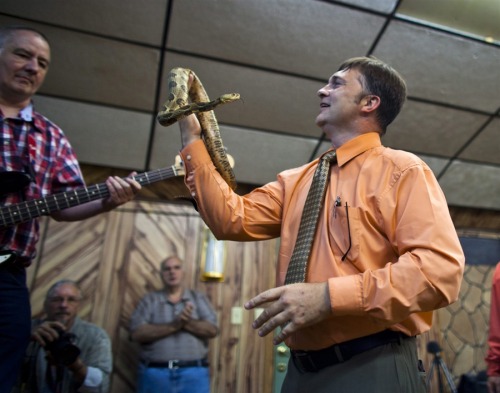
Pentecostal Snake-Handlers


But he answered them, "An evil and adulterous gener-ation seeks for a sign, but no sign will be given to it except the sign of the prophet Jonah." (Matthew 12:39 ESV)
  I lump religious snake-handlers into the vast subset of Christ-followers who covet sign gifts, as if simple faith and trust aren't enough. While Jesus and his followers produced signs to verify their authority, the signs he commanded us to produce are spiritual fruit, not spiritual gifts. Preoccupation with "sign gifts" smacks of carnal pride.
   When I realized the apostate nature of my native, Catholic church, I became skeptical of everything that claimed to be "Christian," and found an alarming body of evangelical teachings that hearkened back to Romanist roots. Even our cherished, Trinitarian teachings originated in Rome, which has caused my reexamination of God's fundamental nature.
   That said, I absolutely believe the eternal, self-existent Word of God, who spoke the universe into existence and established the means of communicating with his creation, is willing and able to provide us with the portion of his truth that is relevant to our temporal frame of reference. His willingness and ability to convey his truth to us, however, does not guarantee our willingness and ability to receive it. As saturation of toxic elements in our bodies blocks absorption of essential nutrients, so intellectual and spiritual error blocks our absorption of the eternal, self-existent One's truth.

   "Reason" has suffered a bum rap from Evangelical Christianity, as a rash reaction to the arbitrarily skeptical brand of reasoning employed by atheists. Carefully choosing the right words to communicate and defend God's good news requires the highest level of reasoning, and indeed, striving to do those works without careful reasoning produces the kind of childish dogmatism that invites attack by free thinkers.

   Personally, I must maintain a critical overview of my own interpretations of God's word. Even if I were qualified to exegete Scripture, I would have no authority to stand dogmatically upon my own conclusions as if they were holy writ.

Friday, October 05, 2012

Entitlements and Other Hogslop

      I haven't given up yet. I still plan to watch the rest of the Presidential Debate, even if I have to hold my nose through it. For these few months, we can forget about trivial issues such as our Constitutional Freedoms and truth in the public arena, as that's all consumed by political rhetoric.
      Both sides of the political aisle placate whatever interest groups they think will benefit them the most come November, remembering, of course, to give lip service to their voter base. Politicians and lawyers share one character trait: We know they are lying when we see their lips are moving. And when the politicians are lawyers?
      Despite all that political hogslop, we need to attend to the business of protecting our Constitution from the powers of self-interest. Pseudo-constitutional hot-buttons such as "reproductive rights," "jobs," "gay rights," "freedom from religion," "gun control," and, "income redistribution" are little more than entitlements that politicians promise with crossed fingers, simply to perpetuate, their lucrative reign of power.
      Our Founding Fathers never intended for the United States to be run by professional politicians, and predicted exactly the sort of abuses that are common today if the Biblical morality they cherished were to be abandoned. Yes, they were idealists, but their ideals made America great, and denying that fact is nothing less than rewriting our history.

More Thoughts About Atheism


      Lately I've found Facebook and YouTube comments dominated by vehement atheistic sentiment focused not at deists, theists, Jews or Muslims, but directly and hatefully at Christians, and I find that curious. Theocracy paranoia peppers these public forums with demands for “Freedom from religion,” and worries about Christian fundamentalist terrorism perpetrated on poor, innocent children who are indoctrinated with Biblical values in Christian homes. Given their way, these secularists would outlaw all religious expression, public or private, and establish their own atheocracy. Thing is, they needn’t go to all that trouble, when they can just move to Communist China and enjoy their atheistic society.

      Atheist claims of openness, free and rational thinking, etc., dissolve like Styrofoam in acetone when they flame Christians with labels ranging from “stupid” to “inbred” to “retard” to “terrorist.” If they are all that passionate, why do they not invest more time in reasonably refuting the opposition, than name-calling? Even those few who offer some rationale for their non-belief seem to be stuck on clichés, rather than concentrating on original thought. Lord knows, atheists have a perfect right to express their thoughts in the public forum, as well as to bear the consequences should they be wrong.

      My personal faith in Christ began as a skeptic's honest inquiry, tempered by an absolute confidence in the Bible as God’s only revealed word, a highly unusual conviction for a Catholic. Because of my confidence in God’s word, I could no sooner blindly accept Catholic, or any other religious dogma—dictated by corrupt ecclesiastical systems—than buy into atheistic dogma—dictated by flawed human reason.

      Upon beholding nature's spectacular beauty and precise order, both creationist and evolutionist explanations seemed markedly hollow and patently dogmatic. The evangelical in-crowd insists on 24-hour creation days, while savvy evolutionists believe the universe created itself. Both propositions require incredible faith, and adherents cling to them with religious fervor. For creationists, that's understandable, but for atheists?

      By their behavior, both sides have eliminated any question as to which has the truth. Their mutual mudslinging tells me both are deceived. The only alternative I have found worthy of pursuing is the only Jewish messiah who fully satisfied all Scriptural prophesy concerning himself, having performed historically verified, unique signs and wonders, proving to unbiased inquirers that he is God’s only Son after his own kind. Jesus of Nazareth lived perfectly, died cruelly, and rose from the dead, not to establish a religion. He did all that to buy back from the enemy of our souls, a faithful remnant, willing to accept God’s love and to love him in return, through their conformity to his righteous example. In contrast to all human religions, in Jesus there is no hatred, bigotry, or cruelty, but only love for his entire creation.

      In view of religion’s track record, I cannot fault atheists for their skepticism, but I do fault them, and human religion’s followers, for their imperious belief that they know all, and that anything outside of their understanding is patently false.